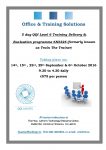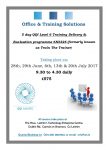
FETAC Level 6 Train the Trainer Programmes for the remainder of 2011

Our August and September 3 day FETAC Level 6 Train the Trainer programmes are now fully booked but we are pleased to announce due to popular demand we have booked two more programmes for 2011

Dates: 26th October, 2nd & 9th November 2011 OR 30th November, 7th & 14th December 2011

Venue: Roscommon Learning Links, Elphin St, Boyle, Co Roscommon

Cost: Special rate of €250 per person

If you are an experienced trainer looking to gain a recognised award and sharpen your training skills or a novice trainer starting out looking to develop the required trainer skills alongside getting an award book by calling Orla on 086 3807802 or email orla@ots.ie

Book early to avoid dissapointment!  For further information download our Train the Trainer FETAC Level 6 outline

Posted in News, Training | Tagged | Leave a comment

The winners and losers in the jobs market this quarter (Source IrishJobs.ie)

According to figures just released by Irishjobs.ie there is very positive sustained growth this quarter (April to June 2011) across many key sectors  compared to this time last year with the winners and losers below … very positive news where the winners are concerned!

The winners…percentage increase since this Q 2010

  • Marketing +61pc
  • HR and Recruitment +59pc
  • Production and Manufacturing +48pc
  • IT +45pc
  • Legal +45pc
  • Sales +44pc
  • Accountancy and Finance +44pc
  • Hotel and Catering  +26pc

The losers – percentage decrease since this Q 2010

  • Environmental, Health & Safety -118pc
  • Beauty/Hair Care -32pc
  • Construction, Architecture and Property – 29pc
  • Retail - 12pc
Posted in News | Tagged , | Leave a comment

Use brainstorming technique to innovatively generate ideas!

Most people have experienced this…you have a blank page waiting to be filled with lots of lateral thinking ideas …but you can’t think of a single idea! Frustrating, yes! How about a brainstorming session with your team/colleagues. Tried that but didnt work? Think again….. if used effectively brainstorming can be a highly effective and useful way of generating ideas, just as long as it’s facilitated well!

A little intro to Brainstorming…

This technique was developed by Madison Avenue advertising executive, Alex Osborn, in the 1950s and combines a relaxed, informal approach to problem-solving with lateral thinking and helps you generate creative solutions to a problem. It asks that people come up with ideas and thoughts that can at first seem to be a bit crazy. The idea here is that some of these ideas can be crafted into original, creative solutions to the problem you’re trying to solve, while others can spark still more ideas. This approach aims to get people unstuck, by “jolting” them out of their normal ways of thinking.

How does a Group Brainstorming session work?

To run a group brainstorming session effectively, do the following:

  • Find a comfortable meeting environment, and set it up ready for the session.
  • Appoint one person to record the ideas that come from the session. Depending on the approach you want to use, you may want to record ideas on flip charts, whiteboards, or computers with data projectors.
  • Define the objective of the brainstorming session clearly, and lay out any criteria to be met. Make it clear that that the objective of the meeting is to generate as many ideas as possible.
  • Give people plenty of time on their own at the start of the session to generate as many ideas as possible.
  • Ask people to give their ideas, making sure that you give everyone a fair opportunity to contribute, including the quietest members of the group
  • Encourage people to develop other people’s ideas, or to use other ideas to create new ones.
  • Encourage an enthusiastic, creative, uncritical attitude among members of the group, Ensure that no one criticizes or evaluates ideas during the session as this stifles creativity and cripples the free running nature of a good brainstorming session.
  • Let people have fun brainstorming. Encourage them to come up with as many ideas as possible, from solidly practical ones to wildly impractical ones.
  • Ensure that no train of thought is followed for too long. Make sure that you generate a sufficient number of different ideas, as well as exploring individual ideas in detail.
  • In a long session, take plenty of breaks so that people can continue to concentrate.
  • Ideas should only be evaluated at the end of the brainstorming session – this is the time to explore solutions further using conventional approaches.

Good luck with your idea generation session!

Posted in Training | Tagged , , | Leave a comment

FETAC Level Train the Trainer, 29th June, 6th & 13th July, 2 places remain@ €250 each

Due to a couple of  last minute cancellations two places have become available on our three day FETAC Level 6 Train the Trainer programme taking place in The Enterprise Centre in Drumshanbo starting next Wednesday 29th June and running over three Wednesdays – 29th June, 6th & 13th July – at a special rate of €250 per person. For more information download our Train the Trainer FETAC Level 6 outline.

A sample of feedback from our most recent Train the Trainer course:

Really enjoyed the whole experience & it has already changed how I approach, plan, deliver and evaluate my courses

I found the training to be very beneficial going forward in designing future programmes

I really enjoyed the three days and it was a real eye opener

My expectations were met & I now feel totally confident that I could conduct a session of training in lots of areas

Many thanks Orla for a very enthusiastic input over the past few days, looking forward to putting learning into practice

I should have done this course ten years ago!

If you would like to book one of these places contact Orla on 086 3807802 or orla@ots.ie.

Posted in News, Training | Tagged , | Leave a comment

Innovative Problem Solving Technique – De Bono’s Six Thinking Hats!

Got a problem that needs solving or a decision to make?

Try Edward De Bono’sDe Bonos Six Thinking Hats® a powerful technique I recently used with  a team of senior managers whilst facilitating a problem solving session – highly effective!

How does it work - This technique is used to look at decisions from a number of important perspectives. When we think we often do so with the same hat on. This technique forces you to move outside your habitual thinking style, and helps you to get a more rounded view of a situation. Many successful people think from a very rational, positive viewpoint but often they may fail to look at a problem from an emotional, intuitive, creative or negative viewpoint. This can mean that they underestimate resistance to plans, fail to make creative leaps and do not make essential contingency plans. Similarly, pessimists may be excessively defensive, and more emotional people may fail to look at decisions calmly and rationally. If you look at a problem with the ‘Six Thinking Hats’ technique, then you will solve it using all approaches.

You can use Six Thinking Hats in meetings or on your own. In meetings it has the benefit of blocking the confrontations that happen when people with different thinking styles discuss the same problem.

Each ‘Thinking Hat’ is a different style of thinking:

  • White Hat: With this thinking hat you focus on the data available. Look at the information you have, and see what you can learn from it. Look for gaps in your knowledge, and either try to fill them or take account of them. This is where you analyze past trends, and try to extrapolate from historical data.
  • Red Hat: ‘Wearing’ the red hat, you look at problems using intuition, gut reaction, and emotion. Also try to think how other people will react emotionally. Try to understand the responses of people who do not fully know your reasoning.
  • Black Hat: Using black hat thinking, look at all the bad points of the decision. Look at it cautiously and defensively. Try to see why it might not work. This is important because it highlights the weak points in a plan. It allows you to eliminate them, alter them, or prepare contingency plans to counter them. Black Hat thinking helps to make your plans ‘tougher’ and more resilient. It can also help you to spot fatal flaws and risks before you embark on a course of action. Black Hat thinking is one of the real benefits of this technique, as many successful people get so used to thinking positively that often they cannot see problems in advance. This leaves them under-prepared for difficulties.
  • Yellow Hat: The yellow hat helps you to think positively. It is the optimistic viewpoint that helps you to see all the benefits of the decision and the value in it. Yellow Hat thinking helps you to keep going when everything looks gloomy and difficult.
  • Green Hat: The Green Hat stands for creativity. This is where you can develop creative solutions to a problem. It is a freewheeling way of thinking, in which there is little criticism of ideas.
  • Blue Hat: The Blue Hat stands for process control. This is the hat worn by people chairing meetings. When running into difficulties because ideas are running dry, they may direct activity into Green Hat thinking. When contingency plans are needed, they will ask for Black Hat thinking, etc.

This technique allows  emotion and scepticism to be brought into what would otherwise be purely rational decisions. It opens up  creativity within decision making and helps  pessimistic people to be positive and creative.

Try it to solve your next problem and make your  decision – it really works! Good luck!

Posted in News, Training | Tagged , , , | Leave a comment

NERA Inspection statistics by Industry (2010)

Summary of NERA Inspections and Breaches detected by Industry Sector in 2010 outlined below. Over 98% of non compliant employers rectified breaches with less than 2% prosecuted  (Source: NERA)

Sector No of Inspections Compliance Rate (%) Unpaid wages recovered (€)
Agriculture 70 37% 17,289
Catering 415 39% 176,600
Retail Grocery & Allied Trade 210 21% 295,245
Hotels 190 25% 153,757
Contract Catering 60 37% 24,913
Security 23 39% 55,253
Construction 383 46% 213,297
Posted in News | Tagged , | Leave a comment

Top 10 Interview Questions – Practice your answers!

While you can’t anticipate every question asked in a job interview, there are certain questions that come up time and time again and you should be prepared for ….

1. Tell me about yourself

This question is often used as an ice-breaker and as a way of putting you at your ease at the beginning of the interview. You should keep the focus on your professional life, highlighting the skills and experience you have that most closely match this position. If used correctly, this is your opportunity to give your opening sales pitch and to influence the future direction of the interview

2. Give me a brief outline of your CV & how your experience relates to the job on offer

This is asked to gain an understanding of your experience and if it links to the job on offer and to determine your interpretation of the job requirements. Remember not all of the interviewers may have completely digested your CV. This is a real opportunity for you to link your experience to the competencies of the job role on offer.

3. Why do you want to work for us?

It’s rare for an interview not to include this question. The good news is that it’s an easy one to prepare for. Most companies want to recruit people who are enthusiastic about the company and its products. They don’t want people on the team who “ended up there by accident”. So this is your chance to show why working for the company is important to you and why you think you will fit in. They will be looking for evidence that you can make a contribution and will be able to grow into the role they are recruiting. This question is designed to screen out candidates who aren’t serious about the company or may be using it as a stop-gap, while they look for something better. It’s also your chance to make the most of the company research you have done. You can use this opportunity to add comments that show you understand the company’s position in the market place; the role of its competitors and any challenges it may be facing.

4. What do you know about this company?

An employer wants to see proof that you are genuinely interested in working for their company and have taken the time to research what they do, where they are positioned in the market place and are aware of recent activities they have been involved in. Much of this information is available online…look at the corporate website and old newspaper articles. By gathering this information, you can use it to position yourself as a commercially aware individual with a strategic and pro-active approach.  If you know someone who does or has worked for the company talk to them to get an inside view

5. Give us an example of a situation where you faced conflict or difficult communication problems

This is not the time to tell the interviewer how much you hate your current boss or colleagues! It’s also not the point to launch into a tirade about how difficult people in your office are to work with and how many arguments you have. So what are they looking for? They’re looking for someone who can rise above conflict and diffuse the emotions, finding a win-win solution. Basically, recruiters want to employ people who will get on well with others, whilst still delivering the company’s objectives. This type of question is your chance to demonstrate your interpersonal and team-working skills. The interviewer will be looking for maturity and the ability to be able to keep your calm, whilst others around you are losing theirs. Don’t feel you have to provide an answer that gives you full credit for the solution – it can often be more powerful (if it’s true) to demonstrate how you worked with others to find a fix.

6. Where do you see yourself in 3/5/10 years time?

Errr… Not a good response!  So what might an employer be looking for with this question?

  • Are you serious about the company? Is the company part of your long-term plan, or are they a stepping stone?
  • Are you serious about your career?
  • Do you know where you want to go?
  • How does this job help you get there?
  • Are you ambitious? This can be positive or negative.
  • How does this job fit within your longer-term plans? Is this job just a stop-gap? If the job is part of your strategy, how likely are you to want to be promoted?
  • Do you have any longer-term plans? They may use this to judge how far you would plan ahead in your new role.

This question is a good opportunity to show your commitment to the role and knowledge of the company’s structure and vision.

7. What would your current/previous manager say are your strengths?

As part of the recruitment process, the employer will have already identified the essential qualities required in a prospective employee and if you can demonstrate that your strengths compliment the job, you will immediately stand out from the crowd. The key competencies and skills will be outlined in the job specification and should guide you as to which strengths to focus on. Highlight three to four key strengths and have an example to back each one up.  We often find it hard to tell people what we’re good at. Selling yourself, without appearing arrogant, is one of the most common interview worries. Many people simply don’t sell themselves, for fear of seeming big-headed but you need to. Ensure to relate the strengths to the position you’re being interviewed for and supply evidence (provide examples)?
Still stuck for answers to this question?

  • You could try asking someone. Ask a trusted friend or work colleague. Make sure they give you examples of where you have demonstrated the strengths, so you can quickly use these, if asked.
  • It’s also worth revisiting the job information, to look for which competencies they are looking for. You will make a more favourable impression if you can cover some of these in your answer.

8. What would your current/previous manager say are your weaknesses?

This is not the place to admit your biggest flaws. It’s also not the time to pretend you don’t have any development areas – it would make you look either conceited or as though you can’t evaluate your own performance. So how should you handle this type of question? The main thing is to admit that you have areas to develop, whilst showing that you are already working on them and giving examples of the progress you have made. Choose a development area that doesn’t affect your ability to do the job for which you are being interviewed or is not noted as one of the key strengths required for the role. It’s usually a good idea to make the “weakness” something small. Avoid topics such as “organizational skills” or “time management”! Be ready to turn it into a positive.

9. Why should we give you this job?

This is the time to give them your USP – Unique Selling Proposition – or what makes you different from all the other applicants. It’s really worth working out and practicing your answer to this before the interview. Some businesses use the phrase “30 second elevator speech”. Imagine you have just bumped into the CEO of the company you want to work for, getting into a lift. He or she asks you “Why should we give you the job?” You have the time it takes for the lift to reach its destination (about 30 seconds) to give a compelling answer. The key is to highlight your strengths and the benefits you can bring to the company. Make sure you avoid sounding desperate! As preparation, you should refer back to the job advert/competencies and also listen carefully during the interview, to make sure your answer meets the needs of the “buyer” (the interviewer). You are giving your answer from the perspective of the buyer’s needs, rather than your own.

10. Do you have any questions you would like to ask us?

Ensure you ask questions! Questions you ask can help differentiate you from the other job applicants. Choose questions that make a great final impression. Whatever you do, make sure you avoid the “anti-climax ending” of not having any questions to ask. It can undo the hard work you’ve done, giving great answers to all their questions. It can make you look uncreative and disinterested – not a great final impression.  Some suggestions to help inspire you: Make your questions relevant, genuine and intelligent. Don’t ask about something that doesn’t interest you; it’ll show in your body language. E.g. what are the three things you most want to know about the job, about the team and/or about the company? What does your interviewer like most about working there? What would they change? Maybe your company research highlighted some questions about the current competitive environment or working practices?  Or maybe you want to know what the interviewer thinks about an aspect of a topic you have already discussed.

At Office & Training Solutions we provide interview preparation coaching– contact orla@ots.ie or 086 3807802 for any assistance you may need. Good luck in your job search!

Posted in News | Tagged , | Leave a comment

FETAC Level 6 Train the Trainer participants sharpening their presenting skills!

Check out our FETAC Level 6 Train the Trainer participants sharpening their presenting skills – a great day with a plethora of subjects including healthy eating, lifesaving techniques, facebook tips, flower arranging, website design, basic computer skills, money saving tips,the basics of composting, autism and how to fix your washing machine!

Posted in Training | Tagged , , | Leave a comment

SWOT Analysis -the key to business planning!

SWOT is an acronym for Strengths, Weaknesses (internal to an organization) , Opportunities & Threats (external to an organization) and is a popular method for helping businesses take stock of their current situation and support decision-making.

The SWOT analysis process……

Step 1 – In the here and now… List all strengths that exist now. Then in turn, list all weaknesses that exist now. Be realistic but avoid modesty!

Step 2 What might be…List all opportunities that exist in the future. Opportunities are your potential future strengths. Then in turn, list all threats that exist in the future. Threats are your potential future weaknesses.

These CONDUCTING A SWOT ANALYSIS questions will provide a basis for this analysis and will help greatly when  brainstorming to thoroughly identify these strengths and weaknesses

Step 3 Plan of action…Review your SWOT Analysis Grid with a view to creating a structured Action Plan to address each of the four areas. In your action plan remember to 1) Allocate timescales, tasks, people responsible, finances and 2) Build in a review process…when, who how…this is VITAL!

In summary;  Strengths (maintain, build and leverage),  Opportunities (prioritise and optimise),  Weaknesses (remedy or exit),  Threats (counter)

Good luck with your SWOT and dont hesitate to contact Orla on 086 3807802 or orla@ots.ie if you would like support to facilitate this process.

Posted in News | Tagged | 1 Comment

FETAC Level 6 Train the Trainer – June/July 2011

Train the Trainer – Boyle June & July 2011

Are you an experienced trainer looking to gain a recognised award and sharpen your training skills or a novice trainer starting out looking to develop the required trainer skills alongside getting an award? If so, the FETAC Level 6 Train the Trainer programme is for you. Ran over three weeks – 23rd, 30th June and 7th July – at a special rate of €250 per person. Down load and complete a pre-course questionnaire to see if this course is right for you Pre Course Questionnaire and email to orla@ots.ie

Posted in News, Training | Tagged | 1 Comment
  • Follow


  • What I'm Doing...

    Posting tweet...

    Powered by Twitter Tools